God of: Sun • Music • Poetry • Prophecy • Healing • Archery • Plague

Apollo

Apollo was a powerful Olympian god known for light and truth—he inspired music and poetry, guided people through prophecy, and could heal… or punish with disease.

Big Idea graphic
Knowledge and talent are powerful tools—but they should be used with responsibility and self-control.
Roman Name: Apollo (same as Greek)
Parents: Zeus and Leto
Spouse(s): None
Siblings: Artemis (twin sister)
Children: Asclepius, Orpheus, Troilus, Aristaeus, Linus, and many more

Background

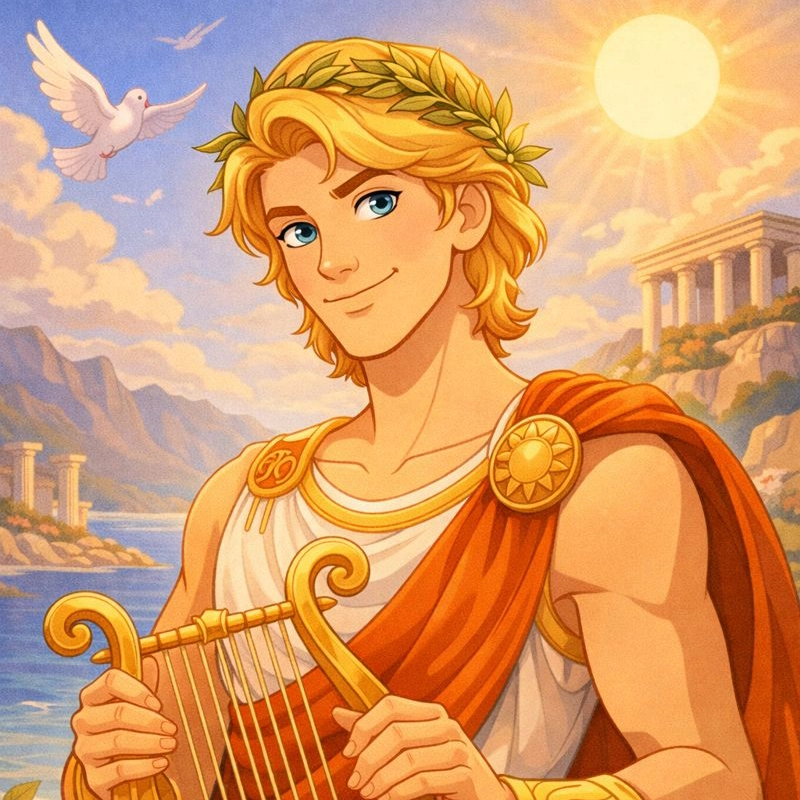
Apollo was one of the most important gods in Greek mythology. He was the son of Zeus and the Titaness Leto, and he had a twin sister, Artemis. Apollo was famous for many different powers—especially music, poetry, healing, and prophecy. In art, he is often shown as a young, handsome god holding a lyre or carrying a bow and arrows.

Apollo’s most famous place of worship was the Oracle of Delphi. People traveled there from all over Greece to ask questions about the future. A priestess called the Pythia delivered Apollo’s messages, and many leaders treated her words as powerful advice.

Apollo was also known as a god of healing, but he could bring sickness too. Myths say that when he was angry, he could send plague as a punishment. Because he was an incredible archer, he was sometimes called the “far-shooter”.

Over time, Apollo became closely connected with the sun. In early myths, the sun’s chariot belonged to Helios, but later stories often describe Apollo as a bright “sun god” who represents light, truth, and order.

Did you know
Apollo’s oracle at Delphi was so respected that city-states and kings sometimes changed big decisions—like going to war—based on the Pythia’s prophecy.

Quick Facts

☀️ Apollo is strongly linked to light, truth, and (in many myths) the sun.
🎶 He is the god of music and poetry, often shown with a lyre.
🏛️ His most famous sanctuary was the Oracle of Delphi.
🏹 He is a master archer, known as the “far-shooter.”
🩺 He can bring healing—but also send plague when angered.

Vocabulary

oracle — a sacred place where people seek messages about the future.
prophecy — a prediction or message believed to come from a god.
purify — to cleanse from guilt or wrongdoing (often through a ritual).
nymph — a nature spirit, often connected to forests, rivers, or mountains.
hubris — dangerous pride or overconfidence.

The Birth of Artemis and Apollo

Leto, a kind and gentle Titaness, was expecting twins—the children of Zeus. But Zeus’s wife Hera was furious and jealous. She declared that no land under the sun could offer Leto a place to give birth. Desperate and in pain, Leto wandered the world, searching for safety.

After a long journey, Leto found the floating island of Delos. It was small and rocky, drifting on the sea and not firmly connected to the earth. Because of this, it was not bound by Hera’s curse. Leto begged the island to shelter her, promising that her children would bring it honor. Delos agreed, and the island became rooted to the ocean floor—finally still and strong.

Hera tried to make things even worse by keeping Eileithyia, the goddess of childbirth, away. Without her help, Leto suffered for nine long days and nights. The other goddesses took pity and secretly brought Eileithyia to Delos. At last, Leto could give birth.

First, Leto gave birth to Artemis, who was strong and independent even as a newborn. Then—helping her mother through the pain—Artemis aided Leto as she gave birth to Apollo. Myths say that when Apollo was born, Delos seemed to glow with golden light, and the world rejoiced.

Apollo and Artemis were twins, but they would rule different parts of the world: Apollo with light, music, and prophecy, and Artemis with the hunt, wild animals, and the moon. Their special bond began on Delos—an island forever remembered as the birthplace of two great Olympians.


Apollo and the Python

After Apollo was born on Delos, he grew quickly into a strong and confident god. He wanted to prove himself and find a sacred place of his own. He soon heard about Delphi, a site where people could seek wisdom about the future. But there was one problem—Delphi was guarded by a monstrous serpent called Python.

Python was a huge, fearsome creature connected to Gaia. The serpent had spread fear across the land and—according to some myths—had even chased Leto when she was pregnant. Apollo decided that Delphi should not belong to a monster, and he set out with his bow.

At Delphi, Apollo found Python coiled around the sacred site. The serpent lunged, but Apollo was quick. He climbed to higher ground and fired arrow after arrow. At last, Apollo’s final shot struck true, and Python collapsed. With the monster defeated, Apollo claimed Delphi as his holy place.

Apollo established his famous oracle there, where the Pythia would speak in his name. People traveled from far away to seek his guidance. But because Python was connected to Gaia, Apollo had to purify himself for killing a sacred creature. Myths say this led to the creation of the Pythian Games, held every four years.

From then on, Apollo’s oracle at Delphi became a symbol of truth and prophecy. Delphi did not just predict the future—it reminded everyone that wisdom and power come with responsibility.

Apollo and Daphne

Apollo was proud of his talents—especially his skill with the bow. One day he mocked Eros, the god of love, for playing with arrows. Insulted, Eros decided to teach Apollo a lesson about power. He used two arrows: a golden one that caused love and a lead one that caused hatred.

Eros struck Apollo with the golden arrow, filling him with love for Daphne, a nymph. Then Eros struck Daphne with the lead arrow, making her want nothing to do with Apollo. Daphne loved the wilderness and freedom and did not want marriage or romance—especially not with a god chasing her.

Apollo ran after Daphne, trying to persuade her with compliments and promises. Daphne fled through the forest, desperate to escape. When Apollo finally closed in, Daphne cried out to her father, the river god Peneus, begging for help.

In an instant, Daphne began to change. Her feet rooted into the ground, her arms stretched into branches, and her skin turned into bark. Daphne became a laurel tree. Apollo stopped, shocked and heartbroken. He gently touched the tree and swore to honor her forever.

From then on, the laurel became sacred to Apollo. Victors and poets wore laurel wreaths as symbols of honor. The story is also a warning: even a powerful god should watch his pride—because hubris can lead to regret.

Apollo and Hyacinthus

Apollo had many companions, but one of his favorites was Hyacinthus, a handsome young prince from Sparta. The two spent time together enjoying sports, hunting, and music. Apollo cared deeply for him, and Hyacinthus admired the bright Olympian god.

One sunny day, Apollo and Hyacinthus were throwing a discus for fun. Apollo hurled it high into the air, and it flashed in the sunlight. Hyacinthus ran forward, eager to catch it when it landed.

Suddenly, a strong gust of wind shifted the discus’s path. It struck Hyacinthus with terrible force, and he fell to the ground. Apollo rushed to him and tried to use his healing power, but it was too late. Some myths say the wind was not an accident—Zephyrus, the west wind, was jealous and blew the discus off course on purpose.

Apollo refused to let Hyacinthus be forgotten. From the young man’s spilled blood, Apollo created a new flower—the hyacinth—and named it after him. The flower became a symbol of remembrance and the sadness that can follow even strong friendships.

Each year, the people of Sparta held a festival called the Hyacinthia to honor Hyacinthus. For Apollo, the story was a reminder that not every loss can be healed—even by a god of healing.

Apollo and Phaethon

Phaethon was a young boy whose mother, Clymene, told him an amazing secret: his father was Apollo, the shining god linked to the sun. Phaethon wanted proof. So he traveled to Apollo’s bright palace in the sky and asked the god to show everyone that he truly was his son.

Apollo welcomed Phaethon and swore an unbreakable oath to grant him any request. That was when Phaethon asked to do something incredibly risky: he wanted to drive the sun chariot for a day. Apollo’s face filled with worry. He warned Phaethon that the fiery horses were wild and the path across the sky was dangerous. But Apollo had promised—and gods could not easily break sacred oaths.

Apollo gave Phaethon careful instructions: hold the reins tightly, stay on the middle path, and do not fly too high or too low. But the moment the horses felt an unfamiliar driver, they bolted. Phaethon panicked. The chariot soared too high, chilling the world, then plunged too low, scorching forests and drying rivers. Earth began to burn.

Zeus saw the disaster and acted before the world was destroyed. He struck the chariot with a thunderbolt. It shattered, and Phaethon fell from the sky like a shooting star. Apollo mourned his son deeply—because he had warned him, but still could not stop the tragedy.

Phaethon’s story became a warning about reckless choices and pride. Even if someone has a powerful parent or big dreams, skill and responsibility still matter. For Apollo, it was a painful reminder that love does not always protect people from consequences.

Explore the Olympians

Click on an image below to learn more about the Olympians: