Goddess of: Wisdom • War Strategy • Craftsmanship • Civilization

Athena

Athena was one of the most respected Olympian goddesses, known for intelligence, careful planning, and fair leadership in both war and peace.

Big Idea graphic
True strength isn’t just power—it’s wisdom, self-control, and making smart choices.
Roman Name: Minerva
Parents: Zeus and Metis
Spouse(s): None
Siblings: Half-sibling to Zeus’s other children
Children: None

Background

Athena is one of the most important deities in Greek mythology. She is the goddess of wisdom, strategic warfare, and craftsmanship. Unlike Ares, who represents chaotic war and bloodshed, Athena embodies discipline, planning, and justice in battle. She is also a protector of heroes, often guiding them with her intelligence.

Athena was born in a truly unique way—she sprang fully grown and armored from the head of Zeus after he swallowed her pregnant mother, Metis, a wise Titaness. This dramatic birth highlights her connection to wisdom and intelligence.

Athena was a beloved goddess in Greece, especially in Athens, the city named in her honor. She won control of the city by gifting the olive tree, which provided food, oil, and wood. The Parthenon, a great temple on the Acropolis, was built in her honor.

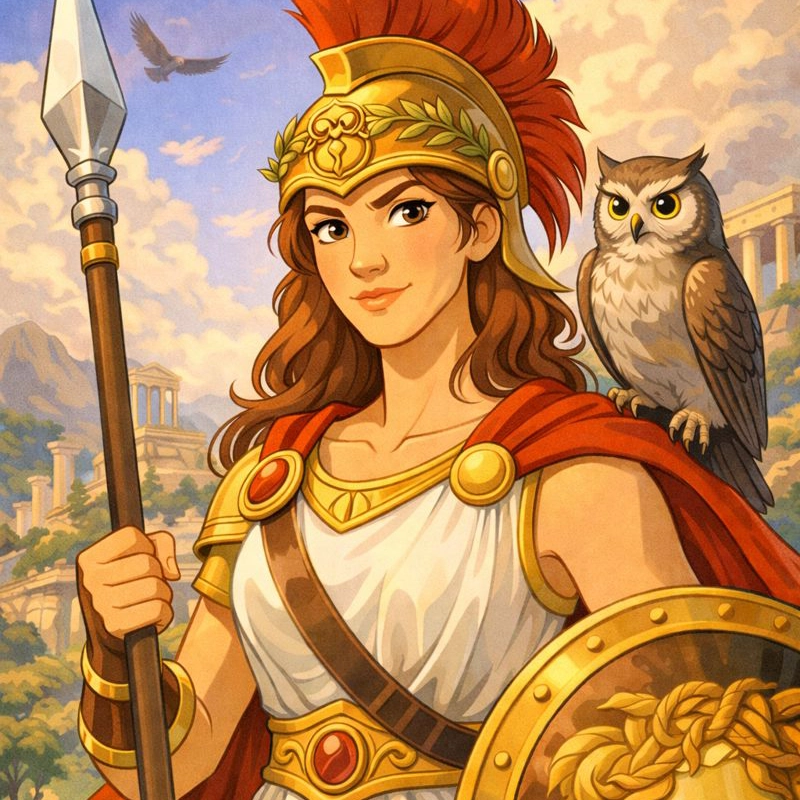
She is often depicted with her shield (the Aegis), a helmet, and a spear. Her sacred animal, the owl, symbolizes knowledge. Unlike many gods, Athena remained a virgin goddess, focusing on duty rather than romantic relationships.

Did you know
The famous Parthenon in Athens was built to honor Athena, and it became a symbol of the city’s pride, power, and culture.

Quick Facts

🧠 Athena is the goddess of wisdom and smart decision-making.
⚔️ She represents strategy and discipline in war (not chaos).
🦉 Her sacred animal is the owl, a symbol of knowledge.
🏛️ The city of Athens was named in her honor.
🧵 She is also a goddess of craftsmanship, including weaving.

Vocabulary

strategy — careful planning to achieve a goal.
prophecy — a prediction believed to come from a god.
hubris — dangerous pride or arrogance.
patron — a protector or supporter of a place or group.
tapestry — a detailed woven fabric or artwork.

The Birth of Athena

Athena, the goddess of wisdom and war, had one of the strangest births in Greek mythology. Her father was Zeus, the king of the gods, and her mother was Metis, a wise Titaness.

One day, Zeus learned of a prophecy that said Metis would give birth to a child who might be more powerful than him. Afraid of being overthrown, Zeus decided to stop the prophecy. When Metis was pregnant, Zeus swallowed her whole, believing this would prevent the child from being born.

For a while, everything seemed fine—until Zeus began having terrible headaches. The pain was unbearable, and he could not find relief. He called for Hephaestus, the blacksmith god, to help him. Following Zeus’s orders, Hephaestus took a mighty axe and struck Zeus’s forehead with all his strength.

Suddenly, Athena burst out of Zeus’s head, fully grown and wearing shining armor. She held a spear in one hand and a shield in the other, and she let out a powerful battle cry. The other gods were amazed by her sudden and unusual arrival.

Athena became one of Zeus’s most trusted children and a powerful protector of heroes. Her birth story explains why she was seen as wise and strong from the moment she appeared: she literally came from the mind of the king of the gods.

Poseidon vs. Athena: The Contest for Athens

Long ago, a new city was rising in Greece, and the people wanted a powerful god to protect them. Two Olympians—Poseidon and Athena—both wanted to claim the city as their own. To settle the dispute, Zeus declared a contest: whoever gave the people the best gift would become the city’s patron.

Proud and strong, Poseidon struck his trident into the rocky ground, and a great spring burst forth. But when the people tasted the water, they realized it was salty and undrinkable. Poseidon argued that his gift would still make them powerful at sea, with ships and naval strength.

Then Athena stepped forward. She knelt and planted a small seed in the earth. As the people watched, a sturdy olive tree grew. Athena explained that the tree would provide wood for building, olives for food, and oil for lamps and cooking. The people saw the many uses of her gift and chose Athena as their protector.

Poseidon was enraged and caused the ground to shake and the seas to rise. But Zeus commanded him to accept the decision. The city was named Athens, and Athena became its honored guardian—showing that a gift that helps people every day can matter more than a gift of fear or force.

The Judgment of Paris

The Judgment of Paris is one of the most important myths connected to Athena because it helped spark the Trojan War—where Athena would later fight fiercely against Troy. The trouble began when Eris, the goddess of discord, was not invited to a grand wedding on Mount Olympus. In revenge, she threw a golden apple into the feast with the words “For the Fairest.”

Three goddesses claimed the apple: Hera, Athena, and Aphrodite. Zeus refused to choose between them, worried they would all become furious with him. Instead, he chose a mortal judge—Paris, a Trojan prince known for his fairness.

Each goddess tried to persuade Paris with a reward. Hera promised him power and a great kingdom. Athena offered something different: unmatched wisdom and success in battle—making him a brilliant leader. Aphrodite offered him the love of the most beautiful woman in the world, Helen of Sparta.

Paris chose Aphrodite’s offer and gave her the apple. Athena was furious—not just because she lost, but because the choice showed poor judgment. Athena believed Paris had traded true greatness for a short-term prize.

When Paris later took Helen from Sparta, the Trojan War began. Athena supported the Greeks and used her intelligence to guide heroes like Odysseus. The myth shows a key Athena lesson: choices made without wisdom can lead to disaster, and even gods may respond when honor and fairness are ignored.

Arachne and the Weaving Contest

Arachne was a young woman famous for incredible weaving. Her patterns were so detailed that people began to believe the gods themselves must have taught her. But Arachne became proud and refused to give Athena, the goddess of wisdom and crafts, any credit. Instead, she bragged that her weaving was better than Athena’s.

Athena heard Arachne’s boastful words and came to her disguised as an old woman. She warned Arachne to be humble and respect the gods. But Arachne laughed and challenged Athena to a contest.

Athena revealed her true form and accepted. The two began to weave, creating magnificent tapestries. Athena wove a masterpiece showing the gods in glory and order. Arachne’s weaving was flawless too—but her tapestry mocked the gods by showing their mistakes and misdeeds.

Athena was furious—not because Arachne was talented, but because Arachne used her talent to insult the gods. In anger, Athena tore the tapestry. Arachne, overwhelmed with shame, tried to take her own life.

Athena stopped her and transformed Arachne into a spider so she could keep weaving forever. The myth became a warning about hubris: talent is impressive, but respect and humility matter too.

Athena and Odysseus

Odysseus, the clever king of Ithaca, was one of the greatest heroes of the Trojan War. After the war ended, his journey home should have taken weeks, but it lasted ten years. Many dangers stood in his way, and he needed more than strength to survive—he needed wisdom. That’s why Athena supported him.

Odysseus faced terrifying challenges: the Cyclops Polyphemus, the witch Circe, the deadly Sirens, and the sea dangers Scylla and Charybdis. Again and again, Odysseus survived by thinking carefully and making clever plans—qualities Athena admired.

After many losses, Odysseus was trapped for years on the island of Calypso. Athena argued on his behalf among the gods, pushing for him to be released. Eventually, Odysseus returned to Ithaca—twenty years after he had left.

When he arrived, Odysseus found his home filled with suitors trying to marry his wife, Penelope. Athena helped him by disguising him as a beggar so he could gather information safely. Then, at the right moment, Athena supported Odysseus and his son Telemachus as they defeated the suitors and reclaimed the kingdom.

This story shows what Athena stands for: smart planning, patience, and self-control. With Athena’s guidance, Odysseus proved that a clever mind can be as powerful as any weapon.

Explore the Olympians

Click on an image below to learn more about the Olympians: