God of: Sea • Earthquakes • Horses

Poseidon

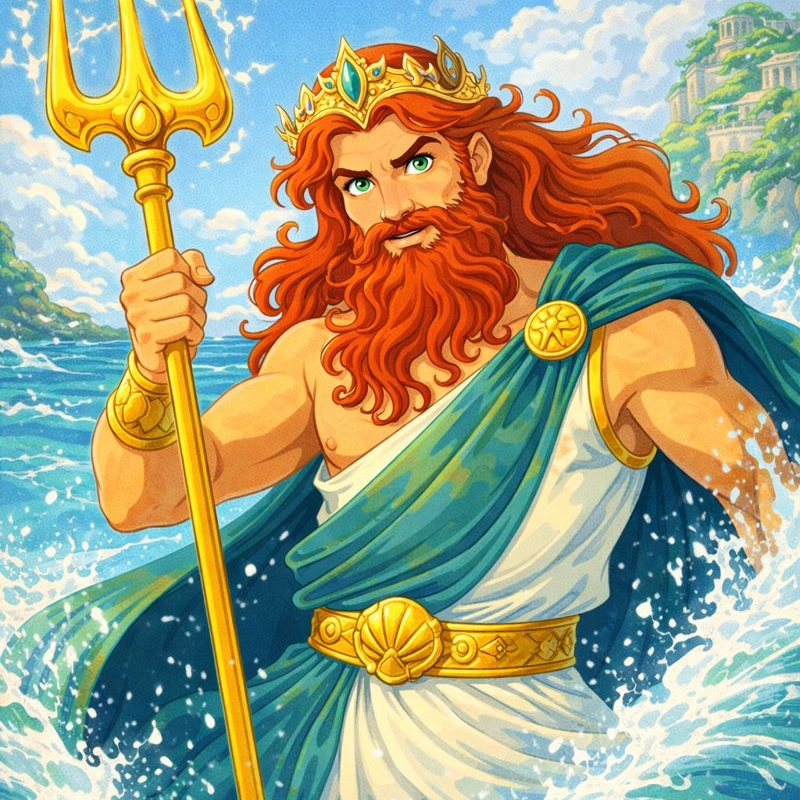
Poseidon is the powerful god of the sea. He rules the oceans with his trident and can calm the waves—or whip them into deadly storms when he’s angry.

Big Idea graphic
Nature can be beautiful and helpful, but it can also be dangerous—respecting its power matters.
Roman Name: Neptune
Parents: Cronus and Rhea
Spouse(s): Amphitrite
Siblings: Zeus, Hades, Hera, Demeter, Hestia
Children: Theseus, Polyphemus, Triton, and many others

Background

Poseidon is the god of the sea, earthquakes, and horses. He is one of the most powerful Olympian gods, ruling over the vast oceans with his mighty trident. Known for his temper, Poseidon could create storms and earthquakes when angered, but he was also revered as the protector of sailors and sea travelers.

His main symbols include the trident, horses, and dolphins. The trident represents his power over the sea, while the horse symbolizes his role as its creator. Poseidon’s Roman name is Neptune, and like his brother Zeus, he was worshipped across the Greek world, especially in coastal cities where the sea was central to daily life.

Did you know
Ancient Greeks sometimes called Poseidon “Earth-Shaker” because they believed he could cause earthquakes when he struck the ground.

Quick Facts

🌊 Poseidon rules the sea and can create storms.
🌎 He is linked to earthquakes and is called the “Earth-Shaker.”
🐎 He is also connected to horses and is sometimes said to have created them.
🔱 His weapon is the trident.
🏛️ His Roman name is Neptune.

Vocabulary

trident — a three-pronged spear; Poseidon’s main weapon.
tempest — a violent storm, especially at sea.
protector — someone who keeps others safe from danger.
patron — a special guardian or supporter of a place or group.
revered — respected and admired deeply.

Poseidon vs. Athena – The Contest for Athens

Long ago, a new city was rising in Greece, and the people wanted a powerful god to protect them. Two Olympian gods, Poseidon and Athena, both wanted to claim the city as their own. To settle the dispute, Zeus declared a contest: whoever gave the people the best gift would become the city's patron.

Proud and strong, Poseidon struck his trident into the rocky ground, and a great spring burst forth. But when the people tasted the water, they realized it was salty and undrinkable. Poseidon declared that with this gift, they would rule the seas, building powerful ships and exploring the world.

Athena then stepped forward. She knelt and planted a small seed in the earth. As the people watched, a sturdy olive tree grew. Athena explained that the tree would provide wood for building, olives for food, and oil for lamps. The people saw the many uses of her gift and chose Athena as their protector.

Enraged, Poseidon caused the ground to shake and the seas to rise. But Zeus commanded him to accept the decision. Though he lost the contest, Poseidon remained one of the most powerful gods, ruling the seas and shaping the fate of sailors and warriors for generations.

The Wrath of Poseidon – Odysseus' Journey

Odysseus, the clever Greek hero, had angered Poseidon in a terrible way. During his journey home from the Trojan War, he and his men landed on an island where they encountered a massive, one-eyed giant named Polyphemus. Polyphemus was a Cyclops, and worse yet, he was the son of Poseidon himself.

Trapped in Polyphemus’ cave, Odysseus devised a daring escape plan. He tricked the giant by getting him drunk and then blinding him with a burning wooden stake. As Odysseus and his men fled the island, he could not resist shouting his real name, boasting that it was he, Odysseus, who had outwitted the Cyclops.

Furious and in pain, Polyphemus cried out to his father, Poseidon, begging for revenge. Poseidon, enraged that a mere mortal had harmed his son, swore that Odysseus would suffer greatly before reaching home. The sea god unleashed powerful storms, giant waves, and monstrous sea creatures to block his path.

For years, Poseidon made sure Odysseus could not return to his homeland, Ithaca. Every time the hero seemed close to safety, another disaster struck. His ships were destroyed, his crew was lost, and he was stranded on distant islands. Even when other gods tried to help Odysseus, Poseidon’s wrath remained strong.

Only after many trials and hardships did Odysseus finally earn the right to return home. With the help of the goddess Athena, he made peace with Poseidon by offering a sacrifice. At last, after ten long years at sea, he stepped onto the shores of Ithaca, proving that even the mightiest gods could not stop a determined hero forever.


Poseidon and the Creation of Horses

Poseidon once fell in love with the goddess Demeter. However, Demeter did not return his feelings and tried to distract him by asking for an impossible task—she told Poseidon to create the most beautiful creature the world had ever seen.

Determined to impress her, Poseidon began shaping animals from the sea foam and earth. He first created great sea monsters, then land creatures like camels, giraffes, and even zebras. However, none of them satisfied him. Finally, he sculpted a magnificent animal, strong and swift, with a flowing mane and powerful legs—the first horse.

As soon as the horse galloped across the land, Poseidon realized he had created something truly special. Though Demeter still did not love him, he had given the world a noble and loyal animal. Horses became symbols of strength and freedom, and they were closely connected to Poseidon, who was often called the “Tamer of Horses.”

To this day, Poseidon is honored as the creator of horses, and many ancient Greeks believed that his spirit lived in the wild stallions that roamed the land.

Explore the Olympians

Click on an image below to learn more about the Olympians: