Artemis
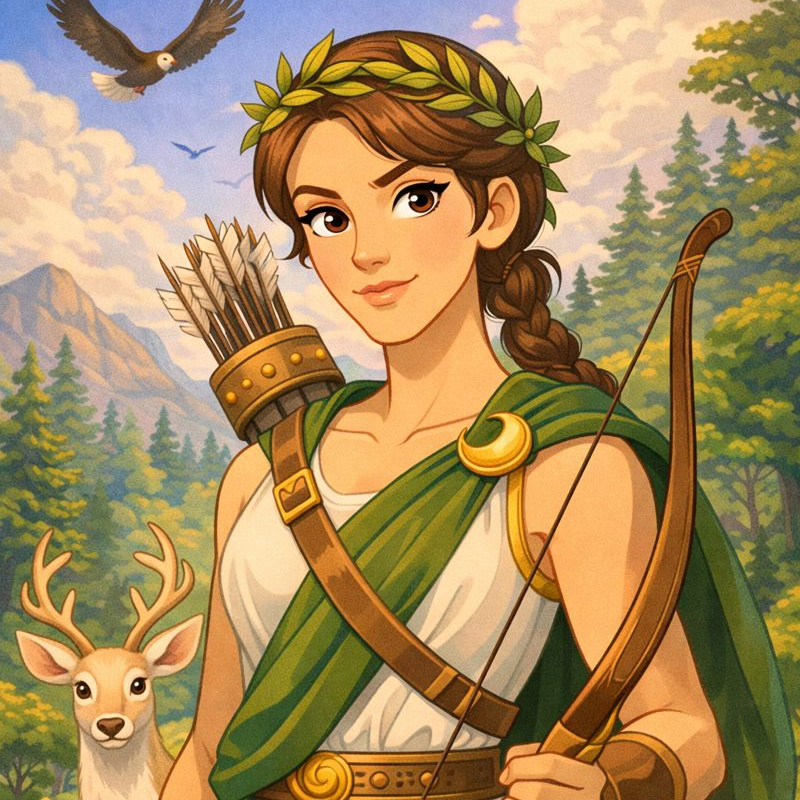
Artemis was an independent Olympian goddess who protected wild places and young people. She was a skilled hunter with a silver bow—and she could be fierce when disrespected.
Background
Artemis was the Greek goddess of the hunt, the wilderness, wild animals, childbirth, and the moon. She was the daughter of Zeus and Leto and the twin sister of Apollo. According to myth, Artemis was born first and then helped her mother deliver Apollo. Because of this, she became connected to childbirth and the care of young children.
Artemis was a virgin goddess who chose independence. She lived in forests and mountains, hunting with her silver bow and arrows, often traveling with a group of nymphs. Artemis protected young girls and punished people who harmed women or animals. But she could also be intense and vengeful when her rules were broken.
Artemis was deeply connected to nature and was believed to bring both life and death. She protected wild animals, yet she was also a skilled hunter. Over time, she became linked to the moon, taking on a role similar to the Titan goddess Selene.
Vocabulary
Notable Stories About Artemis
The Birth of Artemis and Apollo
Leto, a kind and gentle Titaness, was expecting twins—the children of Zeus. But Zeus’s wife Hera was furious. She declared that no land under the sun could offer Leto a place to give birth. Desperate and in pain, Leto wandered the world, searching for safety.
After a long journey, Leto found the floating island of Delos. It was small and rocky, drifting on the sea and not firmly connected to the earth. Because of this, it was not bound by Hera’s curse. Leto begged the island to shelter her, promising that her children would bring it honor. Delos agreed, and the island became rooted to the ocean floor—finally still and strong.
Hera tried to make things even worse by keeping Eileithyia away. Without her help, Leto suffered in labor for nine long days and nights. The other goddesses took pity and secretly brought Eileithyia to Delos. At last, Leto could give birth.
First, Leto gave birth to Artemis. Myths often describe Artemis as strong and independent from the very beginning. Then—because she understood her mother’s pain—Artemis helped Leto as she delivered Apollo. This is one reason Artemis became associated with childbirth and protection.
When Apollo was born, the island seemed to glow with golden light, and the world rejoiced. The twins would grow into powerful Olympians: Apollo connected with music and prophecy, and Artemis connected with the moon, nature, and the hunt. Their bond began on Delos—an island forever remembered as their birthplace.

Actaeon’s Punishment
Actaeon was a skilled hunter who loved exploring deep forests with his pack of hunting dogs. One day, after a long morning of chasing deer, he wandered away from his friends. As he moved through the trees, he came upon a sparkling hidden spring—without realizing Artemis and her nymphs were bathing there.
Artemis valued privacy and had set clear boundaries. No mortal was supposed to see her bathing. But Actaeon—without meaning to—broke that rule. The nymphs gasped and tried to cover Artemis, but Artemis saw Actaeon staring in shock.
Artemis’s anger flared. “How dare you look upon me!” she cried. Even though Actaeon had not planned it, Artemis decided the disrespect could not be ignored. She splashed water at him and declared, “Since you love to hunt, you shall become the hunted!”
Actaeon’s body changed: his hands became legs, his fingers turned to hooves, and his skin became fur. He tried to speak, but only a frightened stag’s cry came out. Artemis had turned him into a deer.
Terrified, Actaeon ran, but his own hunting dogs caught his scent. They did not recognize their master. The dogs chased him down, and the hunter became the hunted. In the end, Actaeon’s fate became a warning: Artemis protected her honor and expected her rules to be respected.
Orion’s Fate
Orion was a mighty hunter, famous for his strength and skill. Some myths say he was the son of Poseidon and could even walk on water. Wherever he went, people admired him, calling him one of the greatest hunters alive.
Orion met Artemis, and they bonded over their love of the wild. They hunted together and spent long days exploring forests and mountains. Some stories describe them as close friends, while others claim Orion wanted to marry Artemis. But Artemis had sworn never to marry, and Apollo did not trust Orion.
There are different versions of Orion’s end. In one, Orion became arrogant and claimed he would hunt every animal on Earth. This angered Gaia, who sent a giant scorpion to stop him. Orion fought bravely, but the scorpion’s sting was deadly.
In another version, Apollo feared Artemis was growing too fond of Orion. One day Orion swam far out into the sea. Apollo pointed to a small dark shape in the water and challenged Artemis to hit it with her bow. Not knowing it was Orion, Artemis fired—and her arrow struck true. When she realized what happened, Artemis was heartbroken.
To honor Orion, Artemis placed him among the stars as a bright constellation. Even today, Orion shines in the night sky—while the scorpion still follows, forever chasing him across the heavens.
Iphigenia’s Rescue
King Agamemnon was preparing to sail to Troy, but the winds would not blow. The sea stayed calm, and the ships could not move. Artemis was angry because Agamemnon had killed one of her sacred deer and bragged that he was a better hunter than she was. To punish him, Artemis stopped the winds and held the entire Greek fleet in place.
Desperate, Agamemnon asked the priests what to do. They claimed Artemis demanded a terrible sacrifice: his daughter, Iphigenia. Agamemnon hesitated, but he feared losing the war before it even began. He sent for Iphigenia, tricking her family by saying she would marry Achilles.
When Iphigenia arrived and learned the truth, she was terrified. The priests prepared the altar and led her forward. At the last moment, Artemis decided what kind of goddess she would be in this story: not only a punisher, but also a protector.
In a flash of divine power, Artemis replaced Iphigenia with a deer and carried the girl away to safety. The winds returned, and the Greeks sailed to Troy—believing Iphigenia was gone.
But Artemis had spared her. She took Iphigenia to a distant land and made her a priestess in Artemis’s temple. The myth reminds readers that Artemis could be strict and demanding, but she could also show mercy when she chose.