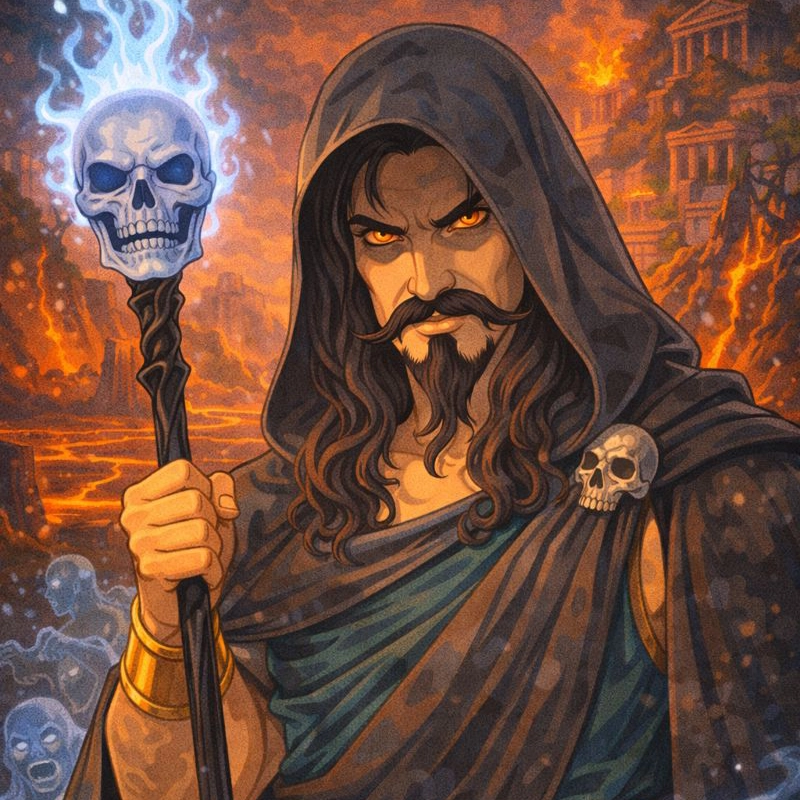
God of: Underworld • Dead • Wealth

Hades

Hades is the god of the Underworld, ruling over the dead and all things beneath the earth. Though his realm is dark and serious, Hades is not “evil”—he is a god of order and balance.

Big Idea graphic
Some jobs are about keeping rules and balance—even when the work is hard and people misunderstand you.
Roman Name: Pluto
Parents: Cronus and Rhea
Spouse(s): Persephone
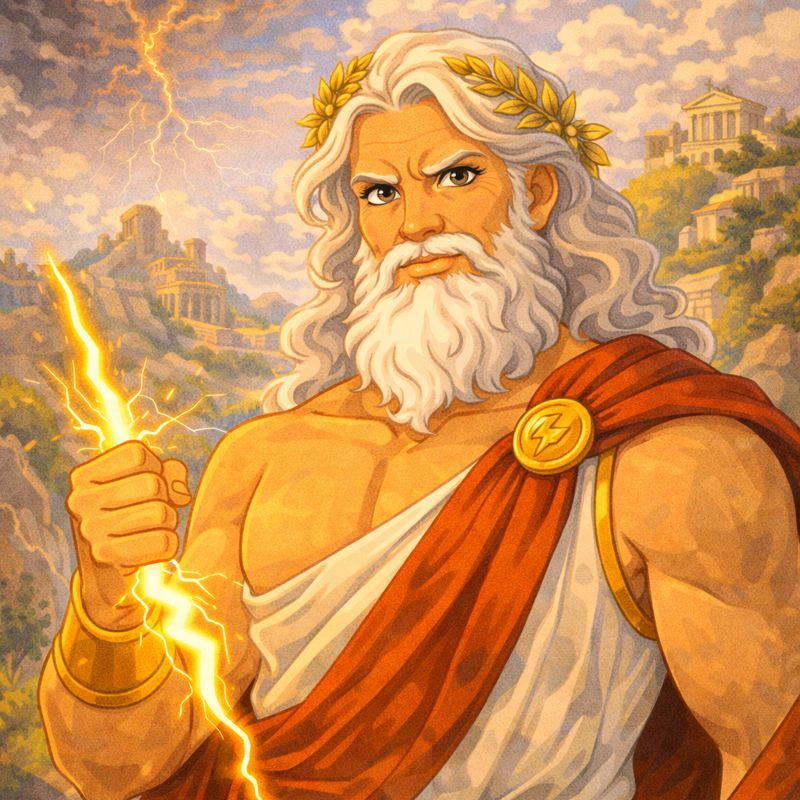
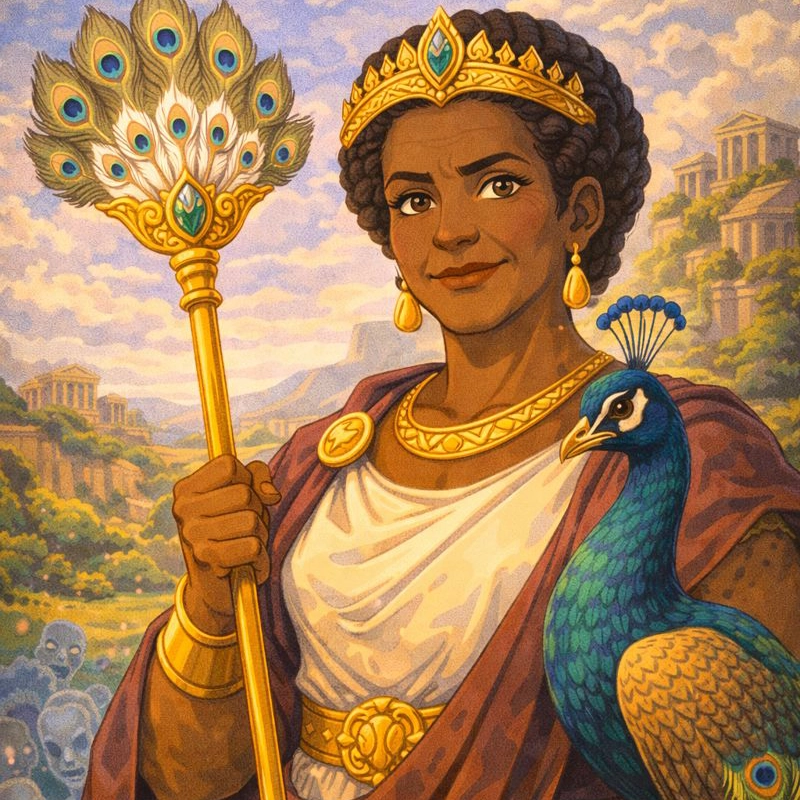
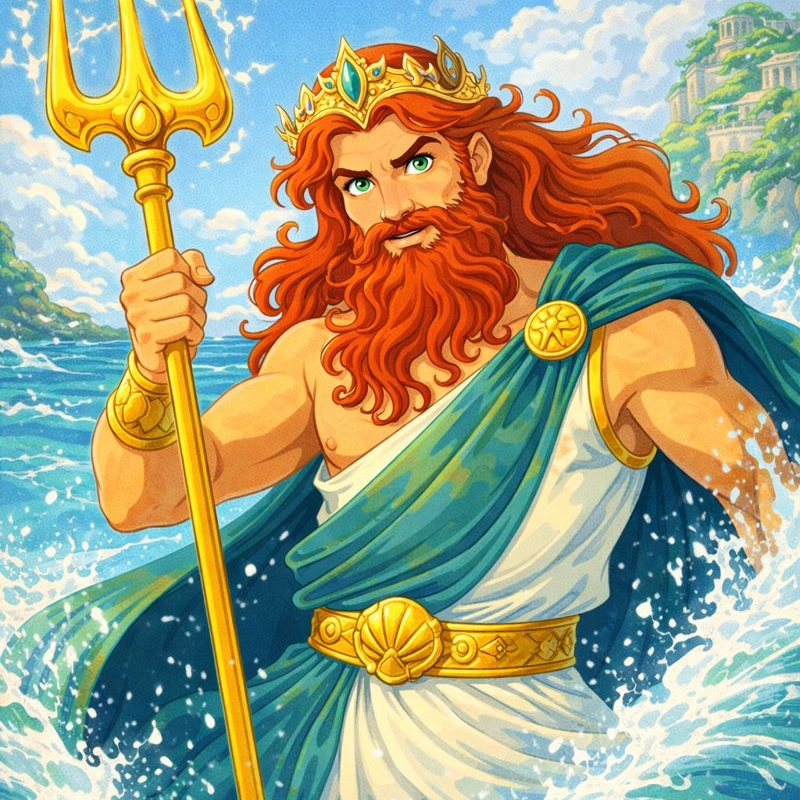
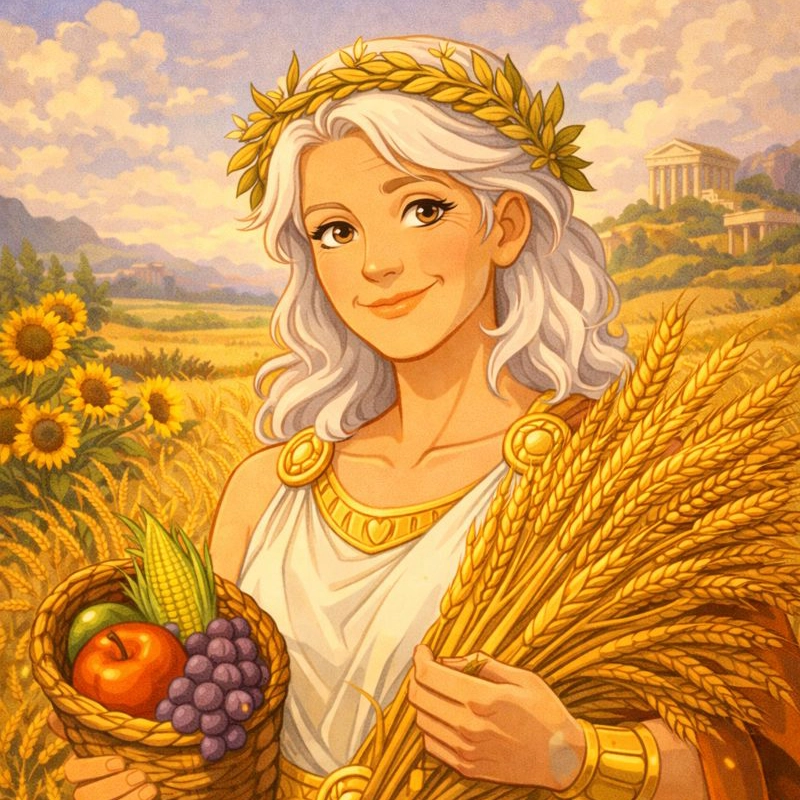
Siblings: Zeus, Poseidon, Hera, Demeter, Hestia
Children: None
Note: Hades is not considered among the twelve Olympians because he lives in the Underworld, not on Mount Olympus.

Background

Hades is the god of the Underworld, ruling over the dead and all things beneath the earth. He is the son of the Titans Cronus and Rhea and the brother of Zeus and Poseidon. When the three brothers defeated their father and the other Titans, they divided the world among themselves. Zeus took the sky, Poseidon took the sea, and Hades was given the Underworld. Though his kingdom is dark and somber, he is not considered evil—he simply ensures that souls go where they belong.

Hades is known for his strict and fair rule. He rarely leaves the Underworld, and mortals fear speaking his name, believing it could bring death. One of his most famous myths is the story of Persephone, whom he took to be his queen. Although this act caused sorrow to her mother, Demeter, it led to the creation of the seasons, as Persephone spends part of the year with her mother and part with Hades.

Hades is often shown with his three-headed dog, Cerberus, who guards the entrance to his realm. He also possesses a helmet of invisibility, a powerful tool that makes him unseen. Despite his fearsome reputation, Hades is a god of balance, ensuring that the natural cycle of life and death is maintained.

Did you know
Hades is tied to “wealth” because gold, silver, and gems come from underground—so ancient Greeks saw those riches as part of his realm.

Quick Facts

💀 Hades rules the realm of the dead: the Underworld.
👑 Persephone is the queen of his realm.
🐶 Cerberus guards the entrance to the Underworld.
🪖 Hades has a helmet that makes him invisible.
💎 He is also linked to underground wealth (metals and gems).

Vocabulary

underworld — the realm of the dead.
soul — a person’s spirit after death.
famine — a severe shortage of food.
eternal — lasting forever; without end.
oath — a serious promise that must be kept.

The Abduction of Persephone: The Cycle of the Seasons

Persephone, the daughter of Demeter, the goddess of the harvest, was a bright and joyful maiden who loved to dance in the meadows, picking flowers with her companions. One day, as she wandered through a field filled with lilies, roses, and violets, she spotted the most beautiful flower she had ever seen—a glowing narcissus. As she reached out to pluck it, the ground beneath her feet trembled, splitting open with a deep, thunderous roar.

From the chasm emerged Hades, god of the Underworld, riding a black chariot pulled by four ghostly horses. With a swift motion, he seized Persephone and pulled her into his chariot. She screamed for help, calling out for her mother, but before anyone could reach her, the earth closed above them, and she was gone. The world above fell silent, but beneath the surface, Persephone was taken deep into the shadowy realm of the dead.

Demeter, upon realizing her daughter was missing, was consumed with grief. She searched every land and sea, calling Persephone’s name, but no one could tell her where the girl had gone. For days and nights, Demeter wandered, refusing to let the earth bear fruit. The grass dried up, trees lost their leaves, and famine spread across the world. Seeing the suffering of mortals, Zeus, the king of the gods, finally took action. He sent Hermes, the swift messenger, to the Underworld to demand Persephone’s return.

In the Underworld, Persephone sat in Hades' dark palace, her heart heavy with sorrow. Though Hades was kind to her, offering her a throne beside his own, she longed for the warm sunlight and her mother’s embrace. When Hermes arrived with Zeus’s command, Persephone’s face lit up with hope. Hades, however, had one final trick—before she left, he offered her a pomegranate. Starving, she ate six small seeds, not knowing that anyone who consumed food from the Underworld was bound to return.

When Demeter and Persephone were reunited, their joy was great, but their happiness was not complete. Because of the pomegranate, Persephone was required to spend six months of each year in the Underworld with Hades and six months with her mother. During the months Persephone is with Demeter, the earth flourishes with spring and summer. But when she returns to Hades, Demeter mourns, and the world grows cold, bringing autumn and winter. Thus, the cycle of the seasons was born.


Orpheus and Eurydice

Orpheus was the greatest musician in the world. His songs could make rivers pause, trees bend toward him, and even wild beasts grow calm. He was deeply in love with Eurydice, a beautiful nymph, and together they were happier than anyone could imagine. But their happiness did not last.

One day, as Eurydice danced in a meadow, a poisonous snake bit her ankle. She cried out in pain and fell to the ground. By the time Orpheus reached her, she had already died, her spirit slipping into the Underworld. Overcome with grief, Orpheus refused to accept her fate. With his lyre in hand, he journeyed to the realm of Hades, determined to bring her back.

As Orpheus entered the Underworld, he played his lyre and sang a song so sorrowful that the spirits of the dead wept. The three-headed dog Cerberus, who guarded the gates, let him pass without challenge. Even the harsh judges of the dead listened in silence. Finally, Orpheus stood before Hades and Persephone, pleading for Eurydice’s return.

Hades was moved by the music, something rarely heard in his dark kingdom. Persephone, too, felt sorrow for the grieving musician. Hades agreed to let Eurydice return to the world of the living—but on one condition. Orpheus must walk ahead of her and never look back until they both reached the surface. If he turned too soon, Eurydice would be lost forever.

Orpheus eagerly accepted the deal. He began his journey up the winding path, his heart pounding. Behind him, he could hear Eurydice’s soft footsteps, but he dared not turn around. As they neared the surface, doubt crept into Orpheus’s mind. What if Hades had tricked him? What if Eurydice was not really there? The moment he stepped into the light, he could bear it no longer. He turned around.

For one brief moment, he saw Eurydice’s face, her eyes filled with love and sorrow. But before she could cross into the world of the living, she was pulled back into the shadows. Orpheus reached for her, but it was too late. She was gone forever.

Heartbroken, Orpheus wandered the earth, singing only songs of loss and longing. He never loved again, and when he finally died, his soul was reunited with Eurydice in the Underworld, where they could never be parted again.

The Twelve Labors of Heracles: The Capture of Cerberus

Heracles, the greatest of all Greek heroes, had been given twelve nearly impossible labors to atone for a terrible crime. His final and most dangerous task was to descend into the Underworld and bring back Cerberus, the three-headed guard dog of Hades. No living mortal had ever entered the realm of the dead and returned, but Heracles was determined to succeed.

Before setting out, Heracles sought guidance from the goddess Athena and the god Hermes. Hermes, the guide of souls, led him to the entrance of the Underworld, while Athena gave him words of wisdom and strength. With his mighty club and lion’s pelt, Heracles stepped into the dark abyss, ready to face whatever lay ahead.

As he walked through the shadowy land of the dead, the spirits of lost souls whispered around him, reaching out with ghostly hands. He passed the river Styx, where Charon, the skeletal ferryman, agreed to take him across in his boat. Even the fearsome three-headed Cerberus could be heard growling in the distance, waiting at the gates of Hades’ palace.

When Heracles arrived before Hades and Persephone, he bowed respectfully and explained his mission. He did not wish to steal Cerberus but had been commanded to bring him to the world above. Hades, impressed by Heracles’ courage, agreed to let him take Cerberus—but only if he could subdue the beast without using any weapons.

Heracles approached the monstrous hound, its three heads snapping and snarling, its serpent-like tail whipping through the air. With his incredible strength, Heracles leaped upon Cerberus, wrapping his powerful arms around the beast’s necks. Cerberus howled and thrashed, but Heracles held on, tightening his grip. Slowly, the beast weakened, its massive heads drooping in submission. At last, Cerberus lay still, defeated but unharmed.

With great effort, Heracles dragged the massive creature up to the world of the living. The sight of the terrifying hound caused people to flee in terror. After presenting Cerberus as proof of his victory, Heracles kept his word and returned the beast to Hades, unharmed. The lord of the Underworld was pleased, and Heracles had completed his twelfth and final labor.

Having conquered death itself, Heracles proved his strength was unmatched. His labors were complete, and his legend would live on forever.

Sisyphus and His Eternal Punishment

Sisyphus was a clever and cunning king, known for his trickery and deceit. He often outwitted gods and mortals alike, always seeking to gain the upper hand. But his greatest trick would also be his downfall, leading him to an eternal punishment like no other.

One day, Sisyphus angered Zeus by revealing one of the gods’ secrets to mortals. Furious, Zeus ordered Thanatos, the spirit of death, to chain Sisyphus and take him to the Underworld. But Sisyphus was not so easily captured. Using his wit, he tricked Thanatos into binding himself with the chains instead. With Death trapped, no one in the world could die. Warriors continued to fight, but no souls passed into the Underworld, disturbing the balance of life and death.

Eventually, Ares, the god of war, grew frustrated that his battles had lost their meaning. He freed Thanatos, who immediately took Sisyphus to the Underworld. But Sisyphus had planned another trick. Before he died, he instructed his wife not to perform the proper funeral rites. When he arrived in the Underworld, he pleaded with Persephone, the queen of the dead, to let him return to the living so he could fix this mistake. Feeling pity, she agreed.

Once back in the world above, Sisyphus had no intention of returning to the Underworld. He continued living as if nothing had happened, defying the gods once more. But his time had run out. Zeus, now truly enraged, ordered Hermes to seize Sisyphus and drag him back to the realm of Hades. This time, there would be no escape.

As punishment for his arrogance, Sisyphus was given an impossible task. He was forced to push a massive boulder up a steep hill. Each time he neared the top, the rock would roll back down, forcing him to start over. No matter how hard he tried, he could never succeed. His struggle would last for eternity.

And so, Sisyphus remained in the Underworld, endlessly pushing his boulder, a symbol of eternal struggle and the consequences of trying to outsmart the gods.

Pirithous and Theseus in the Underworld

Pirithous and Theseus were two great heroes, bound by an unbreakable friendship. They had fought side by side in battle and sworn to help each other find worthy wives. But their ambition led them to make a terrible mistake—one that would take them to the Underworld and cost them dearly.

Having already helped Theseus kidnap Helen of Sparta, who was still too young to marry, Pirithous set his sights even higher. He wished to marry Persephone, the queen of the Underworld. Theseus, though uneasy, had sworn to aid his friend in all things, so together they made the perilous journey to Hades’ dark realm.

As they entered the Underworld, they passed through the gates guarded by Cerberus, the monstrous three-headed hound, and stood before the throne of Hades and Persephone. Hades, amused by their boldness, did not refuse them outright. Instead, he invited them to sit upon a grand stone bench. Unaware of the trap, Theseus and Pirithous sat down—and instantly, they found themselves unable to move. The bench was cursed, binding them in place with invisible chains.

Trapped in the Underworld, the two heroes sat helplessly as the days turned into months. Their bodies weakened, and their hopes faded. Hades had no intention of freeing them; their foolishness had sealed their fate. Time passed, and in the world above, Theseus’ kingdom fell into chaos without its king.

At last, Heracles arrived in the Underworld as part of his twelve labors. Seeing Theseus and Pirithous bound to the stone, he pitied them. Using his great strength, he tore Theseus free from the cursed seat, breaking the magic that held him. However, when he tried to free Pirithous, the ground trembled, and Hades’ voice echoed through the halls. The crime of attempting to steal Persephone was too great—Pirithous would never leave the Underworld.

With no choice, Theseus left his friend behind and returned to the world of the living. Pirithous remained trapped in eternal punishment, a warning to all who dared challenge the gods. Theseus, though free, was never the same again, haunted by the fate of his lost companion and the price of their reckless ambition.

Explore the Olympians

Click on an image below to learn more about the Olympians: