Hera
Hera is the queen of the Greek gods and the wife of Zeus. She is the goddess of marriage and family, often seen as the protector of women and mothers.
Background
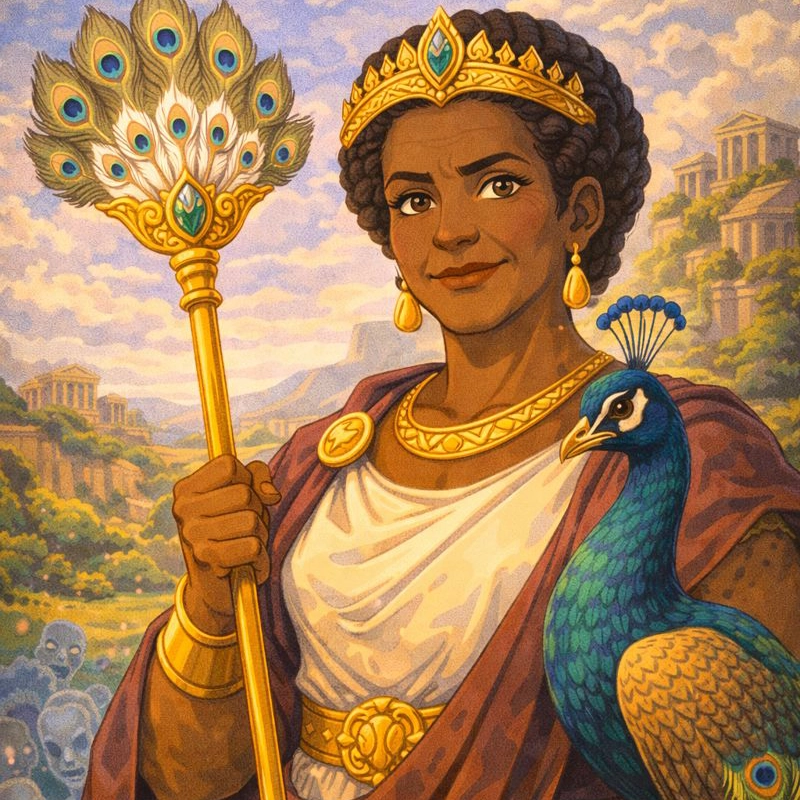
Hera is the queen of the Greek gods and the wife of Zeus. She is the goddess of marriage and family, often seen as the protector of women and mothers. As the most powerful goddess of Mount Olympus, Hera is known for her regal and commanding presence. She was often depicted wearing a crown or diadem, symbolizing her role as queen of the gods, and holding a scepter as a sign of her authority.
Hera was deeply devoted to marriage and was often portrayed as a jealous and vengeful wife due to Zeus’s many affairs. Despite this, she was also a symbol of loyalty, strength, and dignity. Her sacred animals include the peacock, cow, and cuckoo, which represent beauty, fertility, and watchfulness.
As a major deity in Greek mythology, Hera played an essential role in many myths, particularly those involving heroes such as Heracles and Paris of Troy. She was both a protector and an avenger, ensuring that justice was served for those who wronged her.
Vocabulary
Notable Stories About Hera
Hera and Heracles – The Trials of a Hero
Hera held a deep hatred for Heracles, the son of Zeus and a mortal woman, Alcmene. Furious over her husband's infidelity, she sought to make his life as difficult as possible. Even as a baby, she sent two serpents to kill him in his crib, but Heracles, showing his immense strength, strangled them both with his bare hands.
As he grew older, Hera’s influence continued to shape his life. She made sure that his journey would be filled with suffering. When he became an adult, she drove him into a fit of madness, causing him to attack and kill his own wife, Megara, and their children. When he awoke from his madness and realized what he had done, he was filled with grief and despair.
Seeking redemption, Heracles went to the Oracle of Delphi, who told him to serve King Eurystheus of Mycenae. Eurystheus, influenced by Hera, gave him twelve seemingly impossible tasks, known as the Twelve Labors. These included slaying the Nemean Lion, capturing the Golden Hind of Artemis, stealing the Apples of the Hesperides, and even venturing into the Underworld to capture Cerberus.
During his labors, Hera often tried to make things even harder for him. When he fought the Lernaean Hydra, she sent a giant crab to distract him. When he went to retrieve the girdle of Hippolyta, Queen of the Amazons, she spread false rumors, turning the Amazons against him. Despite all these obstacles, Heracles completed each task, growing stronger and proving himself as one of the greatest heroes of Greek mythology.
Though Hera never fully forgave him, in the end, Heracles was granted immortality and allowed to join the gods on Mount Olympus. Ironically, he and Hera eventually reconciled, and she even allowed him to marry her daughter, Hebe, the goddess of youth. This marked the end of her long-lasting feud with the greatest hero of Greece.
The Judgment of Paris
One of the most famous stories involving Hera is the Judgment of Paris. It all began when Eris, the goddess of discord, was not invited to a grand wedding on Mount Olympus. In revenge, she threw a golden apple into the gathering, inscribed with the words “For the Fairest.” Instantly, Hera, Athena, and Aphrodite claimed the prize, each believing herself to be the most beautiful.
To settle the dispute, Zeus refused to choose between them, fearing their anger. Instead, he appointed Paris, a Trojan prince known for his fairness, to decide. The goddesses each tried to persuade Paris by offering him a reward. Hera promised to make him the ruler of the greatest empire in the world, giving him power and wealth beyond imagination. Athena, the goddess of wisdom and war, offered him unmatched intelligence and success in battle. Aphrodite, the goddess of love, promised him the love of the most beautiful woman in the world—Helen of Sparta.
Paris, enchanted by Aphrodite’s offer, awarded her the golden apple. This decision enraged both Hera and Athena, who vowed revenge against him and his people. Paris soon learned the consequences of his choice when he took Helen away from her husband, King Menelaus of Sparta. This act led to the outbreak of the Trojan War, a conflict that would last for ten years and end in the destruction of Troy.
Throughout the war, Hera remained a fierce enemy of the Trojans, using her influence to aid the Greek forces. She worked alongside Athena to sabotage the Trojans, supporting Greek heroes like Achilles and Odysseus. Even when the war seemed to favor Troy, Hera ensured that fate would bring about their downfall, proving that her wrath was not easily forgotten.
The Judgment of Paris was one of the most pivotal moments in Greek mythology, as it set the stage for one of the greatest wars ever told. It also showed how Hera, despite being a goddess of marriage and family, could be ruthless when slighted. Her power and influence over mortal affairs made her one of the most formidable deities of Mount Olympus.
The Birth of Artemis and Apollo
Leto, a kind and gentle Titaness, was expecting twins, the children of Zeus. But Zeus’ wife, the powerful and jealous Hera, was furious. She declared that no land under the sun could offer Leto a place to give birth. Desperate and in pain, Leto wandered across the world, searching for a safe place for her children to be born.
After a long journey, Leto found the floating island of Delos. It was a small, rocky place, drifting on the sea, not firmly connected to the earth. Because of this, it was not bound by Hera’s curse. Leto begged the island to shelter her, promising that her children would bring it great honor. Delos agreed, and the island became rooted to the ocean floor, finally still and strong.
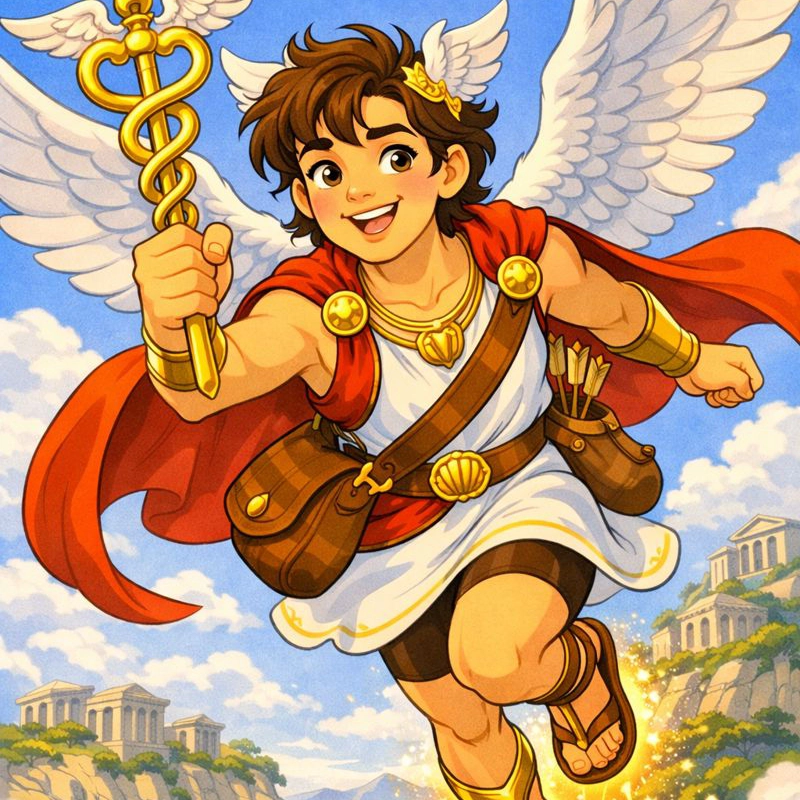
But Leto’s troubles were not over. Hera had forbidden Eileithyia, the goddess of childbirth, from helping Leto. Without her, Leto suffered in labor for nine long days and nights. The other goddesses took pity on her and sent Iris, the messenger of the gods, to secretly bring Eileithyia to Delos. At last, Leto was able to give birth.
First, she brought her daughter, Artemis, into the world. The newborn goddess was strong, wise, and independent. Almost immediately, she helped her mother through the pain of childbirth. With Artemis’ aid, Leto then gave birth to her second child, Apollo. As soon as he was born, the island bloomed with golden light, and the world rejoiced.
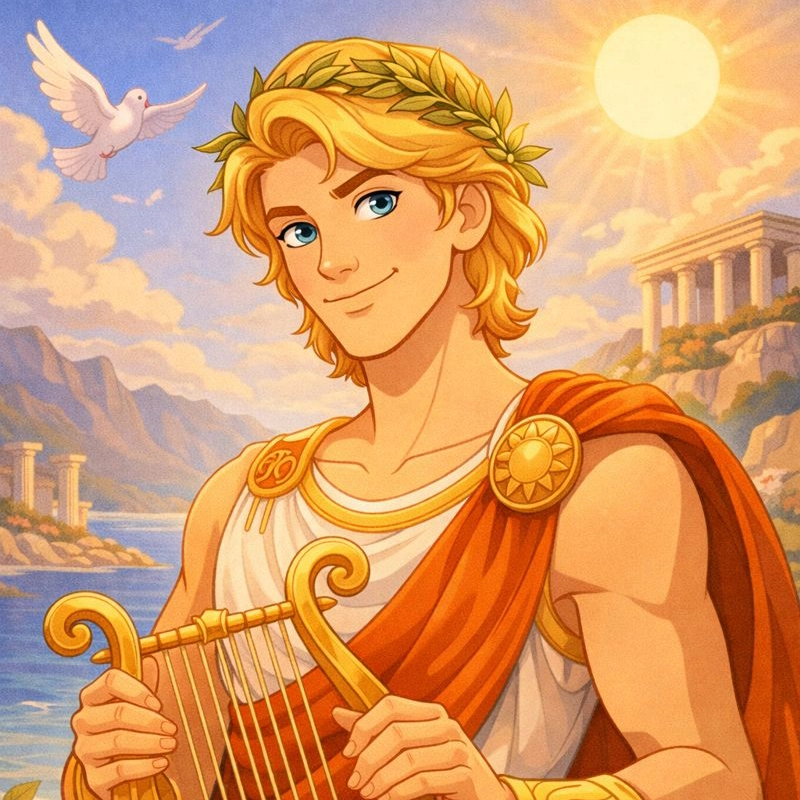
Apollo and Artemis were twins, but they were different in many ways. While Apollo would become the god of the sun, music, and prophecy, Artemis was destined to be the goddess of the moon, the hunt, and wild animals. Though they had different paths, they would always share a special bond as twin siblings.
Because of their birth, Delos became one of the most sacred places in Greece. Apollo and Artemis would grow into powerful gods, each ruling over light in their own way—Apollo with the sun and prophecy, and Artemis with the moon and nature. Together, they brought balance to the world, and their mother, Leto, was honored for giving birth to two of the greatest Olympian gods.